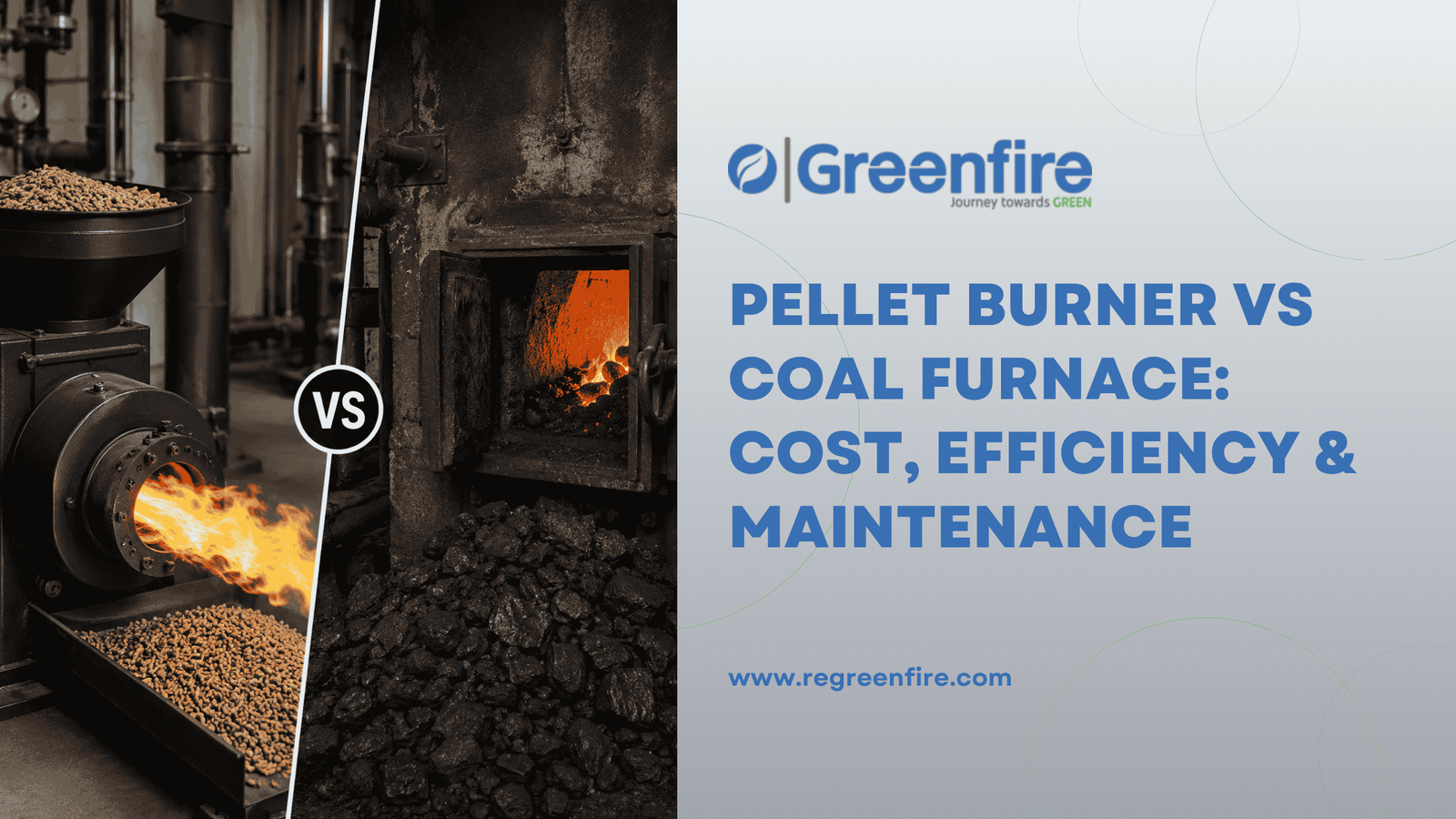
If you're running a boiler and thinking about switching fuels, you're not alone. A lot of plant managers and facility heads are asking the same question right now. With fuel prices going up, emissions regulations tightening, and the pressure to reduce the cost of operations, the old ways are being questioned.
The bottom line when considering the difference between a biomass pellet burner for boiler systems and the old-school coal furnace is three things: what you are paying, what you are getting and how much trouble it is. Let's do it right.
Pellet Burner vs Coal Furnace: Which Is Better for Industrial Boilers?
Biomass Pellet Fuel Pellet Stove
- Compatibility with the boiler system design
- Automatic fueling
- lower pollution
Coal Fuel
- Operates on either soft or hard coal
- Outdated technology
- Manual fueling
- Higher carbon emissions
Upfront Cost: Which One Costs More to Install?
Pellet Burner
- Moderate investment
- Retrofit-friendly
- Govt. subsidies available
- ROI in 2–4 years
Coal Furnace
- Lower equipment cost
- Existing systems usable
- No incentives
Coal wins on day-one price, no argument there. But the moment you factor in pollution control equipment, ash handling, and compliance upgrades, that gap starts to disappear. Most facilities that switched say the pellet burner paid for itself faster than expected.
Fuel Cost: What Are You Paying Every Month?
Pellets Biomass
- Pricing stability
- Local options
- Bulk discounts are available
- Cheaper agricultural waste pellets
Coal Industry
- Volatility in price
- Import dependent
- No local replacement
- costs driven by the market
This is where coal quietly breaks down your budget. One bad quarter on global coal markets and your fuel bill spikes with nothing you can do about it. A biomass pellet burner for boiler operations gives you far more control over monthly energy spend, especially when you source pellets regionally or buy in bulk.
Efficiency: Which One Actually Burns Better?
Pellet Burner
- Thermal efficiency 85-92%
- Pellet size uniformity
- Automatic air control
- Low heat output
Coalburner
- 60-75% efficiency.
- Variable coal quality
- Manual stoking is losing
- Unburned particle waste
This efficiency differential is major in terms of real numbers. If your fuel costs ₹1 lakh per month, then a difference of even 20 percent in efficiency translates to burning up nearly ₹20,000 worth of coal each and every month in sheer waste.
Emissions & Compliance: The Part You Can't Ignore
Pellet Burner
- Near carbon-neutral fuel
- Meets EU & international norms
- Low particulate output
- No sulphur dioxide
Coal Furnace
- High CO₂ and SO₂ output
- Facing industrial bans
- Non-compliant in many zones
- Penalties increasing
This isn't a future problem — it's a current one. Emission regulations are already catching up with coal-heavy industries across Asia, Europe, and beyond. Running a coal furnace today means budgeting for compliance costs tomorrow. A biomass pellet burner for boiler systems puts you ahead of that curve rather than scrambling to catch up.
Maintenance: How Much Hassle Are You Signing Up For?
Pellet Burner
- Automated ash disposal
- Less buildup of soot
- Yearly service
- parts easy to obtain
- Remote monitoring capability
Coalburner
- Heavy ash and slag.
- Routine manual cleaning
- Hard to find parts
- Skilled Technician Needed
Anyone who has run both systems will tell you coal maintenance is a never-ending job. The cleaning alone takes man-hours every week. Pellet burners are built for cleaner combustion, which means less residue, less wear, and far fewer unplanned shutdowns.
Storage & Handling: Practical Day-to-Day Reality
Pellet Burner
- Dry silo or bag storage
- Automated auger feeding
- No dust or mess
- Compact footprint
Coal
- Large storage area needed
- Heavy and dusty
- Manual shovelling
- Moisture affects quality
The day-to-day handling difference is something that doesn't show up in comparison charts but absolutely shows up in your team's workload. Pellets are clean, compact, and easy to manage. Coal is heavy, dusty, and weather-sensitive. For any facility thinking about workplace conditions, biomass pellets are simply easier to live with.
Long-Term Value: The Bigger Picture
| Factor | Biomass Pellet Burner | Coal Furnace |
| Efficiency | 85–92% | 60–75% |
| Emissions | Low / Compliant | High / Restricted |
| Fuel Cost Stability | High | Low |
| Maintenance Effort | Low | High |
| Future-Proofing | Strong | Declining |
| Upfront Cost | Medium–High | Low |
Long-Term Return on Investment
While many companies consider only the cost of purchasing an item, ROI speaks volumes.
Costs of Using Coal Furnace
These could be:
- More fuel usage.
- More labour.
- Operating expenses
- Environmental Protection Costs
- Cost of compliance.
Pellet Burner Benefits
Ways to save money can include:
- Lower fuel consumption.
- Lower labor costs.
- Less maintenance costs.
- Increased energy efficiency.
- Less costs related to environmental regulations.
In the long run, burning biomass pellets in a burner in a boiler system should yield considerable financial savings over coal-powered operations.
Which Option Is Better for Modern Industries?
A coal furnace might also be suitable in cases where the existing coal system has been developed. Nevertheless, companies that are cost-conscious and sustainable opt for biomass fuel.
The benefits of using pellet boilers include:
- Increased efficiency
- Clean combustion
- Less maintenance
- Fewer emissions
- Automation
- Long-term savings
It is due to these benefits that pellet boilers have become more popular for modern industrial processes.
Final Word
Coal had a good run. But between the fuel volatility, the compliance burden, and the efficiency losses, it's costing more than it used to save. A biomass pellet burner delivers better efficiency, cleaner combustion, lower running costs, and a setup that won't be flagged by regulators next year.
For boiler operators ready to make that move, Regreenfire builds pellet burner solutions for real industrial demands, not just showroom specs.
FAQs
Q1. Is a biomass pellet burner cheaper than coal in the long run?
Yes. Higher efficiency, lower maintenance, and stable fuel pricing usually make pellet burners more economical over time.
Q2. Can I retrofit a pellet burner to my existing boiler?
In most cases, yes. Modern pellet burners are designed to integrate with many industrial boiler systems.
Q3. What amount of maintenance will a pellet burner require?
A pellet burner requires less maintenance compared to coal-based equipment due to minimal ash formation.
Q4. Are biomass pellets environmentally friendly?
Yes, biomass-based pellets are environmentally friendly since pellets can be recycled.